2026/03/11 14:54
◇English below
木版染めとは
木製の版(スタンプ)を用いて布に模様を捺す技法です。
木を彫って版を作り、布に染料や媒染剤・防染剤を直接捺しつけます。
手作業ならではの版ズレやかすれが、温かみのある表情を生み出すのが魅力です。
世界各地に独自の木版染めが存在しますが、特にインドの「ブロックプリント」がその代表格として知られています。
はじまり~版を捺して転写する
スタンプは古代メソポタミアで使用されたのが起源とされています。
メソポタミア・エジプト、インダス、中国……それぞれ独自のスタイルの印章(スタンプ)が発展しました。 ※スタンプの歴史や解説はコチラへ
技術の応用~染める?伝える?
インド
古くから高度なテキスタイル産業が存在したとされています。
特にモヘンジョダロで発見された綿布の断片が、茜(赤色)で染色されていたことは驚きです。※天然染料による植物繊維の染色は難しいのです!
そして紀元前後には植物染料を化学的に定着させる「媒染」と木版とを組み合わせた技法が発達していたとされています。
エジプトのアフミーム(4世紀頃)からは、インド製と思われる木版染めによる布片が出土しています。
その後、インドでの木版による染色「ブロックプリント」が、世界へ広まっていきます。
中国
前漢の馬王堆漢墓(前2世紀)から、木版を用いた「印花(版画式染色)」布が出土しています。
紙が普及する以前に、布への装飾として木版技術が確立されていました。
隋・唐代(7世紀)には紙の普及とともに、プリント技術は布から紙へと転用されていきます。
仏教経典などが大量複製され、日本には8世紀頃、仏教とともに中国(唐)から伝わりました。
代表的なものは770年に完成した「百万塔陀羅尼」で、これは現存する「印刷年代が明確な世界最古の印刷物」になります。
こうして木版は「布への装飾」から「情報の複製技術」へと発展し、グーテンベルクの活版印刷や日本の浮世絵とつながっていきます。
インドのブロックプリント
17世紀以降、ヨーロッパで一世を風靡し、あまりの需要の高さに自国の産業保護のため一時期輸入が禁止されるほどの社会現象となりました。
その後、イギリスで「シリンダー捺染機」が発明され、手作業から機械化による大量生産への転換、すなわち「産業革命」の口火を切ることになったのです。
現在でもブロックプリントは、インド各地で作られており、その土地独特の特徴を持つ人気の伝統工芸品です。
 ▲インドで入手した木製スタンプ
日本の木版染め
伝来と衰退
木版を用いた染色は、奈良時代に製紙や印刷技術とほぼ同時期に「夾纈(きょうけち)」という染色技法が伝わりました。
インドのブロックプリント(スタンプを用いた凸版)とは違い、夾纈は文様を彫られた2枚の木版に布を挟んで染料を流し込む板締めです。
室町時代末期から江戸時代にかけて、外国の商船によってインド製のブロックプリントは、他の更紗(※)と共に日本に持ち込まれました。
しかし、日本では木版染めは主流になりませんでした。
日本では優れた和紙が作れたため、渋紙を用いた型染め(孔版)の方が細密な表現ができ、しかも効率的だったのです。
木版染めと型染め~鍋島更紗
慶長年間に朝鮮半島から渡来した九山道青によって、木版と型紙を併用した技術が確立されたと伝えられています。
その技術は鍋島藩の保護を受け「鍋島更紗」として発展し、一子相伝で受け継がれていきました。
しかしその後、廃藩置県によって献上が廃止となり、1900年代初頭に途絶えてしまいました。
昭和初期に染色家の鈴田照次氏らによって復元され、現在は「木版摺更紗」として佐賀県で受け継がれています。
※更紗と和更紗
更紗とは、インドや欧州から伝わった染めた木綿の生地をさします。
江戸中期以降に更紗を模した、日本独自の技術(主に型染め)で作った木綿布「和更紗」が誕生します。
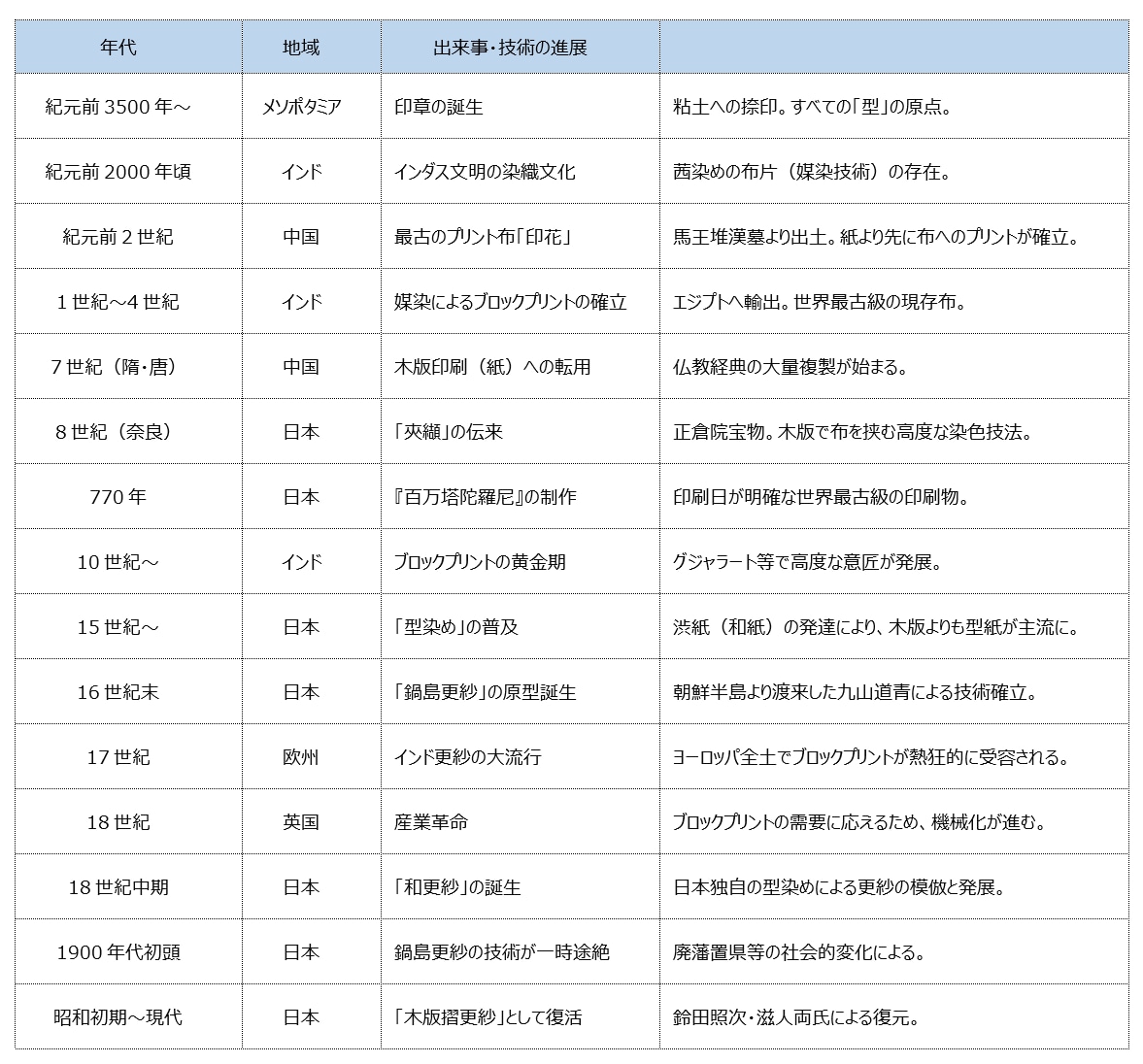
簡単なまとめ
舞鶴工房の木版染め
舞鶴工房の木版染めは、印章彫刻を起点として生まれました。
印章彫刻の道具や技術を応用して制作しており、一般的な木版染めとは異なる点もあるかもしれません。
木材を印刀で彫り、布に捺印する手法で、現時点では計算された連続模様ではなく、モチーフを用途や気分に応じて捺印する楽しみ方をしています。
また、鍋島更紗への敬意を込めて、型染めも併用しています。
インドのブロックプリントのようにダイナミックでカラフルな表現ではなく、安定した輪郭線が特徴かもしれません。
今後、手法を変えることもあるかもしれませんが、現時点ではこのように制作しています。

What is Woodblock Printing?
Woodblock printing is a technique in which wooden blocks (stamps) are used to print patterns onto fabric.
The blocks are carved from wood, and dyes, mordants, or resist agents are applied directly to the fabric through stamping.
Irregularities such as slight misalignments or fading—characteristic of handwork—create a warm and charming expression.
Distinct styles of woodblock printing exist all over the world, but India’s block printing is especially well known as a representative example.
Origins – Stamping and Transferring Designs
The use of stamps is believed to have originated in ancient Mesopotamia.
Unique styles of seals and stamps developed in Mesopotamia, Egypt, the Indus Valley, and China.
*For a detailed history of stamps, see here.
Applications – Dyeing or Communicating?
India
India has had an advanced textile industry since ancient times.
Remarkably, fragments of cotton fabric discovered at Mohenjo-daro were dyed with madder (red).
Dyeing plant fibers with natural dyes is notoriously difficult!
Around BC - AD, techniques combining mordants—which chemically fix plant dyes—with woodblocks had already developed.
Fragments of woodblock-printed fabrics, believed to have originated in India, have also been excavated in Ahmim, Egypt(around 4th century).
Subsequently, block printing in India spread to other parts of the world.
China
From the Mawangdui Han Tombs(2nd century B.C. Western Han), fabrics printed using woodblocks have been excavated.
Before the widespread use of paper, woodblock techniques were already established for decorating cloth.
By the Sui and Tang dynasties(7th century), as paper became more common, printing techniques were adapted from cloth to paper.
Buddhist sutras and other texts were mass-produced, and around the 8th century, these techniques were introduced to Japan along with Buddhism from China(Tang).
A notable example is the “One Million Pagoda and Dharani Prayers” completed in 770 CE, considered one of the oldest surviving printed texts with a clearly known printing date in the world.
In this way, woodblock printing evolved from decorating cloth to a technique for reproducing information.
Indian Block Printing
From the 17th century onward, Indian block prints became extremely popular in Europe, creating such high demand that imports were temporarily banned to protect local industries.
Subsequently, the cylinder printing machine was invented in UK, marking the shift from handwork to mechanized mass production—effectively igniting the Industrial Revolution.
Even today, block printing continues to be produced across India, with each region offering distinctive characteristics and popular traditional crafts.

▲from India
Japanese Woodblock Dyeing
Introduction and Decline
Woodblock dyeing was introduced to Japan during the Nara period(710-794), around the same time that papermaking and printing techniques were being adopted, in a method known as Kyōkechi.
Unlike Indian block printing, which uses raised stamps, Kyōkechi involves sandwiching the fabric between two carved wooden blocks and pouring the dye, a technique known as itajime(clamp-resist dyeing).
From the Muromachi period(1336-1573) through the Edo period(1603-1868), Indian block-printed fabrics were imported to Japan via foreign merchant ships, along with other types of calico.
However, woodblock dyeing did not become mainstream in Japan.
Because Japan produced high-quality washi paper, katazome (stencil dyeing using papers) allowed for finer patterns and was more efficient.
Woodblock and Stencil Dyeing– Nabeshima Sarasa
During the Keichō era(1596–1615), Kyuzan Douzei immigrated from Korea and said to have established techniques that combined woodblocks and stencils.
This technique developed under the protection of the Nabeshima Domain (All of present-day Saga and part of Nagasaki Prefecture), becoming known as Nabeshima Sarasa, some of the techniques were passed down orally.
After Meiji Restoration(1868), the practice of presenting these textiles as tribute ended, and the craft nearly disappeared by the early 20th century.
In the early Showa period(1926-1989), dyeing experts such as Teruji Suzuta revived the technique, and today it is preserved in Saga Prefecture as Mokuhan-zuri Sarasa.
Sarasa and Wazarasa
Sarasa refers to cotton fabrics dyed in styles imported from India or Europe to Japan.
From the mid-Edo period onward, Japan developed its own techniques, mainly stencil-resist dyeing, to imitate sarasa, producing cotton fabrics called Wazarasa.
Our Woodblock Printing
Maizuru Studio’s woodblock printing originated from Japanese seal engraving techniques.
The workshop applies the tools and skills of seal carving, which may result in differences from conventional woodblock printing.
Blocks are carved using seal knives, and patterns are stamped onto fabric.
At present, the designs are not calculated as continuous patterns; rather, motifs are stamped according to the intended use or the maker’s mood, creating a playful and flexible approach.
Out of respect for Nabeshima Sarasa, stencil dyeing is also incorporated.
Unlike the dynamic and colorful expression of Indian block prints, the work may be characterized by stable and precise outlines.
The techniques may evolve over time, but this is the current approach at Maizuru Studio.